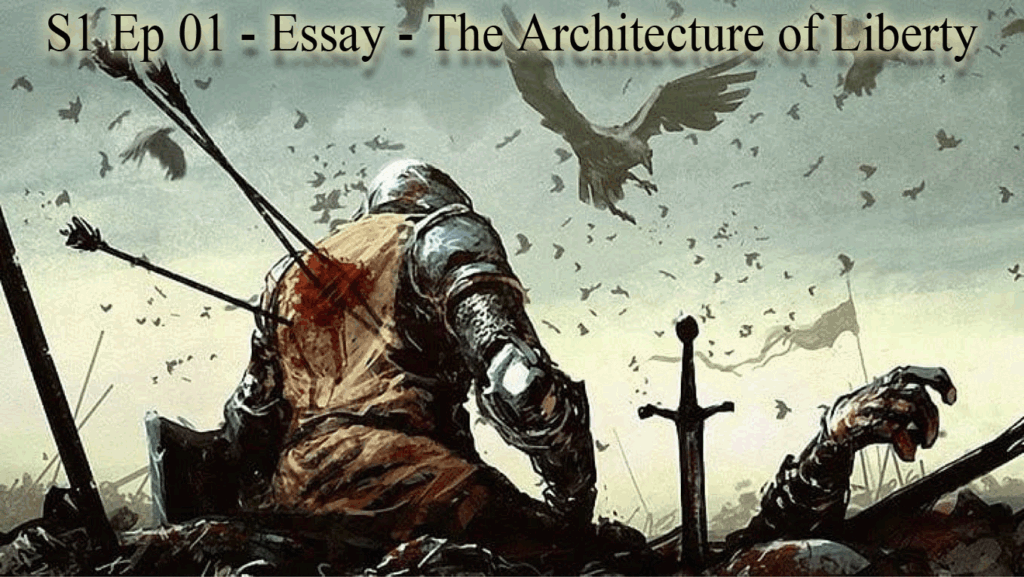
An Examination of Individual Agency, Spiritual Warfare, and the Reclamation of the Gentlemen’s Code in a World of Inversion
S1 Ep 01 Essay
Introduction
For years, I have navigated the turbulent waters of modern existence, wrestling with questions that seem to have been systematically erased from public discourse. We are told what to think, how to speak, and even what to believe about our own identity. The air is thick with a manufactured fog of confusion, designed to obscure a fundamental truth that once formed the bedrock of Western civilization: that the individual, endowed with inalienable rights by their Creator, is the primary unit of society. This truth, enshrined in the Declaration of Independence, is not merely a historical artifact but a living, breathing principle that we must re-learn, re-claim, and fiercely defend. Our current societal sickness stems from a grand inversion, a satanic perversion of this natural order that seeks to dehumanize us, to turn us from sovereign beings into dependent subjects. This presentation will explore the foundational principles of liberty, the nature of the spiritual conflict we face, the practical discipline of sober living, and the reclamation of the gentlemanly code as essential components of a life lived with purpose, courage, and integrity.
The Inversion of Power: Sovereign Individual vs. The Leviathan State
The most critical concept we must first internalize is the proper relationship between the individual and the governing body. The Declaration of Independence clearly articulates that governments are instituted among men, deriving their just powers from the consent of the governed. This is not a license for tyranny, but a limit on it. The government is a servant, created to secure the inherent rights of the people, not to bestow them. Yet, we are living through an age of what I call the “satanic inversion,” where this pyramid is turned upside down. The state, or the globalist cartel that runs it, positions itself as the master, and the individual is reduced to a mere subject, a resource to be managed, a problem to be solved. This is the very essence of collectivism, whether it manifests as socialism, communism, or fascism—it is all the same poisonous fruit from the same rotten tree. Its goal is to erode the individual’s sense of self-reliance and agency, making us dependent on the system for our survival and, therefore, compliant to its will.
To see this, one need only observe the relentless assault on every marker of individual liberty. The arbitrary mandates, the weaponization of public health policy, the redefinition of language, the dismantling of the nuclear family, and the promotion of a culture of victimhood all serve a single purpose: to condition the populace to accept their subjugation. We are told that our safety and security must be sacrificed for the “greater good,” a nebulous concept that invariably serves the interests of the few at the expense of the many. But who defines this “greater good”? It is always those in power, seeking to expand their control. History teaches us that every tyrant uses the same playbook, cloaking their power grabs in the language of compassion and necessity. As a man, a sovereign individual, my first duty is to see through this deception. It is to remember that God is above me, and below Him, I am the master of my own life. No human institution has the moral authority to claim ownership over my conscience, my property, or my destiny. The consent of the governed is not a one-time event; it is a daily, conscious affirmation, and when that consent is betrayed by a “long train of abuses and usurpations,” as the founders so eloquently stated, it is not only our right but our duty to alter or abolish that government and provide new guards for our future security. This is the patriotic duty of a gentleman in a time of crisis.
The Nature of the Conflict: World War III of Powers and Principalities
Understanding this political reality is only half the battle. The true war we are fighting is not of a physical nature, but a spiritual one. It is a conflict of “powers and principalities,” as the scripture states—an age-old war between the forces of good and evil. This is not a metaphor or a political talking point; it is the fundamental reality of our existence. The forces of evil are organized, deliberate, and ruthless in their objective: to destroy the world, to murder and enslave humanity, and to make life miserable for the survivors. They are not merely mistaken or misguided; they are actively malicious in their intent. Their goal is to dehumanize us, to strip us of our God-given dignity and turn us into chattel. They want us sick, docile, and spiritually dead.
Many good people struggle to see this reality because they have been blinded by the materialist worldview, which reduces everything to economics and politics. They see the chaos and hardship but attribute it to incompetence or bad policy. I believe this is a fatal error in judgment. Until you recognize that you are dealing with an evil force that is antithetical to God and humanity, you cannot begin to fight it. This is the context in which we must place the grievances we hold against the state. The tyrannical actions of the modern government are not just political overreach; they are the actions of a system that has become an instrument of evil. To stand idly by and do nothing is not neutrality; it is complicity with the oppressor. We must pick a side and we must fight.
But how do we fight? How do we engage in a spiritual war? The first step is to arm ourselves with truth. The forces of evil operate on a foundation of lies. They thrive on deception and confusion. When you drill down into a lie with the truth, you will see the liar’s weakness. They become angry and evasive because the truth exposes their falsehood. Conversely, someone grounded in truth is unafraid of exploration and debate. The truth has a power and a resonance that is immediately felt. It is our most potent weapon. We must be vigilant in discerning the truth from the narrative, and we must speak it boldly and unapologetically. We must also recognize that in this war, the sword of the spirit is our primary weapon, but there is also a time for the sword of steel. We must be men who are willing to act with courage and conviction to protect ourselves, our families, and our communities from the forces that seek to destroy them. To be a peacemaker in this context is not to be a passive observer, but to actively and courageously confront evil and create a space where peace and justice can flourish. We must have the discernment to know when to speak and when to act, and the conviction to do both with unwavering resolve.
The Ethic of the Individual: Sobriety and Self-Mastery
The battle against the external forces of evil begins with the internal battle for self-mastery. This is why sobriety is so critical to the mission of a free man. My journey into sobriety began many years ago, and I can personally attest to its transformative power. In my days of drug and alcohol consumption, I was unhappy, unproductive, and lacked any real zest for life. I was not free. I was a slave to a chemical that clouded my judgment, dulled my ambition, and hindered my ability to be a force for good in the world. Sobriety is not about following a set of rules imposed by a collective; it is about a personal choice to reclaim one’s agency and to live a life of clarity and purpose.
The very nature of the addiction industry, particularly the widespread legalization of certain substances, is a tool of subjugation. By keeping a significant portion of the population sedated and pacified, the elite can more easily control them. A man who is sober is a man who is awake. He can think critically, make sound decisions, and act with precision. He is not driven by impulse or dependency but by conscience and reason. This does not mean a man cannot enjoy life; it means he chooses the higher pleasures of a sound mind and a healthy body over the fleeting, illusory comfort of intoxication. The most effective societies never make sobriety a mandate; they simply make the case for it and allow individuals the freedom to choose. But we must be honest about the consequences of not choosing it. We must be living examples of the benefits of a clear mind, a strong body, and a spirit that is free from the shackles of addiction.
Self-mastery extends beyond sobriety to encompass all aspects of our lives. It means disciplining our bodies through proper exercise and nutrition, being mindful of our posture and breathing, and challenging ourselves to grow and improve. It is a rejection of the mindset of the victim, which is so prevalent in our culture. A sovereign man takes full responsibility for his own well-being. He does not blame others for his failures or wait for the state to rescue him. He is a source of strength for his family and his community, not a drain on its resources. This individual ethic is the foundation upon which a free society is built. When each man takes command of his own life, the collective power of a free people becomes an unassailable force against tyranny. The battle for liberty starts in the mirror, with the decision to become the best version of oneself, free from the chains of addiction and dependency, ready to serve a cause greater than oneself.
The Reclamation of the Gentleman: Truth, Honor, and the Sacred Masculine
Finally, the project of building a free and virtuous society requires the reclamation of the noble ideal of the gentleman. The term has been sadly corrupted in our modern age, often used to describe a man who is weak, passive, or obsequious. I believe we must restore the classical definition, which is rooted in the principles of chivalry and honor. A gentleman, as I see it, is a man of his word. In a world drowning in lies and deceptions, a man who speaks the truth is a revolutionary figure. It is a difficult path, fraught with challenges and persecution, but it is the only path of integrity. A gentleman vows to never knowingly tell a lie. He thinks before he speaks, listens more than he talks, and holds himself accountable for everything he says. This creates a life of peace, a solid foundation upon which to build a legacy. When he lays his head down at night, he can do so in peace, knowing he has been a force for good.
The concept of the gentleman is inseparable from the recognition of the sacred masculine. There are two genders, male and female, and to deny this reality is to deny the very fabric of creation. The entire planet is organized around this duality, and men have a unique and irreplaceable role to play in society. This role is not about dominance or oppression, but about protection, provision, and leadership. A gentleman is a protector—a guardian of the weak, the vulnerable, and the innocent. He is a provider, using his strength and intellect to create abundance for his family and community. He is a leader, not through coercion, but through the force of his character and example. He is bold, outspoken, brave, and better. He rejects the emasculation pushed by the culture, which seeks to neuter men into compliant, confused shadows of their true selves.
A true gentleman is a peacemaker, but one who knows that true peace often requires courage. He is not afraid to use the sword of the spirit to rebuke evil, and he is willing to use the sword of steel to protect his loved ones if necessary. He is a man of action, a “doer,” not merely a thinker. He embraces his divine potential with unwavering courage and conviction. He lives a life worth living, he does his part to manifest a godly realm full of peace, love, and abundance. This is not a call to arrogance, but to a sacred duty. It is a call to reclaim the lost art of chivalry, not as a historical curiosity, but as a living code for modern manhood. It is about reclaiming the power of the masculine in its most righteous form—as a force for good, truth, and honor in a world that desperately needs it. By becoming living examples of these principles, we may inspire others to follow, and through our collective efforts, build a better world.
Conclusion
In conclusion, the path forward for the man who seeks to live a life of meaning and purpose in this chaotic world lies in a threefold reclamation: of liberty, of self, and of honor. We must first understand the proper relationship between the sovereign individual and the government, recognizing the satanic inversion of power that seeks to make us slaves. This understanding must be grounded in a deep awareness of the spiritual conflict that is the true nature of our times, a battle of powers and principalities that demands we choose a side and act with courage. This battle cannot be won without the internal discipline of sobriety and self-mastery, which frees us from the addictions that bind us and allows us to think clearly and act effectively. Finally, we must embrace the noble ideal of the gentleman, a man of truth, honor, and the sacred masculine, who is a protector, provider, and leader in his home and community.
This is not a passive philosophy; it is a call to arms. It is a call to action, to be engaged, to be a co-creator in this world. The opportunity for a life of abundance, peace, and love is given to us. We must seize it with unwavering courage, build our own lives with conviction, and lead by example. We must do our part to manifest goodness in this world. We are not helpless pawns in a grand game; we are the children of God, endowed with free will and the power of choice. We are the authors of our own destiny. The time for fear and inaction is over. It is time to stand tall, to speak truth, to act with courage, and to build the world we want to see. The future of our families, our communities, and our civilization depends on it.
Leave a Reply